
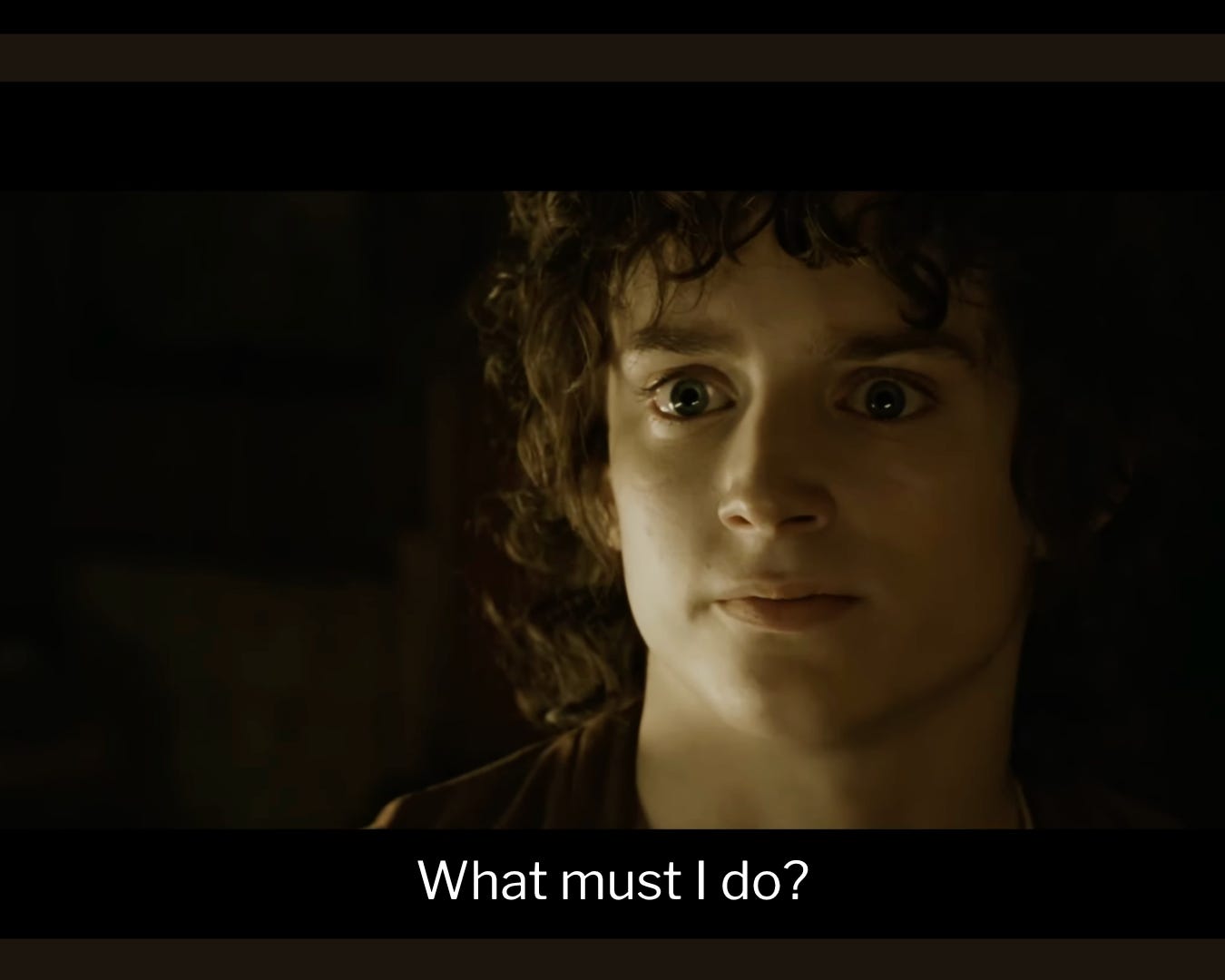
What must I do?
You did it to me, Part Three

This is part three of three in a series on the impact of immigration enforcement, which grew out of a paper that I submitted for a news writing class this spring. Part One and Part Two are available to read now.
One of my favorite scenes in the Lord of the Rings movie trilogy is near the beginning. Gandalf has just told Frodo the horrifying backstory of his inherited magical ring. Frodo is beginning to understand that the ring is a danger to his home and anyone near it.
He realizes that the ring must be taken far away, but he also knows that the person who carries it will be in grave danger. There are so many things that Frodo could do at that moment. It would be easy to shrug off any responsibility and decide that this is too big of a problem for a little guy like him. Instead he looks up at Gandalf with eyes full of fear and a heart full of courage, and asks, “What must I do?”
I think about that scene often when I hear stories like the ones we have covered in the last few weeks. People are living in fear, and for good reason. Our government is involved in corruption and injustice, and those involved are growing wealthy off of their schemes. These problems are big. They feel impossible to solve.
We could easily join the ranks of the many who look away, make excuses, or freeze under the weight of it all. Or we can be like Frodo, knowing that there are hard things ahead of us but accepting that we must take some responsibility for the collective good.
We can ask, “What must I do?”
Unlike Frodo, the answer probably does not involve a deadly journey. However, it’s also unlikely that the answer is as straightforward as the one that Frodo received. As much as we would like for there to be a wise council who tells us what to do and where to go to do it, we will need to do some of our own work to find our role.
I certainly don’t have an easy answer for you (or even for myself), but I would like to share some ideas and resources. Some may apply to you and some may not, but I hope that you can find something that resonates.
I would also love to hear more ideas in the comments if there is anything that you would like to add.
Listen well
The first thing that many of us must do is pay attention. We don’t have to know the details of every breaking news story or respond immediately to every crisis. But if we keep a baseline level of awareness about the state of our communities, we are better able to both respond and educate others.
There are many organizations currently doing great reporting and storytelling work about the ways that our broken immigration system continually breaks people, and there are good sources across the spectrum of political or religious ideologies.
Some of the organizations that I have found helpful in tracking immigration news over the last five years or so are the American Immigration Council, the National Immigration Forum, and Transactional Records Access Clearinghouse (TRAC). A couple of Substacks that are helpful in keeping up-to-date with immigration news are Austin Kocher and Neighbor Notes. Some faith-based organizations that work both at the U.S.-Mexico border and with immigrant communities across the U.S. include Abara, Border Perspective, and FaithWorks. We Choose Welcome does a great job of synthesizing important information on social media and providing action prompts.
Plugging into resources like these is a great start, but online resources cannot replace embodied relationships. One of the best ways to stay informed and truly make a difference is to make local or regional connections with those most affected by these issues. Knowledge holds little significance without proximity or relationship to those living this reality. Find those doing the work in your hometown, county, or state, and follow their lead.
Speak the truth
In the Academy 4 mentoring program that my husband and I have participated in for the last several years, we teach our 4th graders that listening is something that we do with our whole bodies. Sometimes I think adults need that reminder too.
It’s not enough to hear the words that someone is telling us, or even to believe what they say. When someone tells us that they are being hurt, that information requires a response.
After the 2020 murder of George Floyd we heard a lot about social justice and it felt like change was finally on the horizon. People were “listening and learning.” There was a wave of webinars, books, and more for people to dig into U.S. history and learn how to strive for a more equitable world.
However, many of us never got past this “listening and learning” stage. We changed our minds about some things and tried to be less racist (in theory), while still not rearranging anything about our personal lives. We cannot keep doing this.
We should absolutely listen, and we should absolutely learn. We should also take a hint from Maya Angelou and when we know better, actually do better.
One of the simplest—but also one of the most challenging—ways to help when facing wide-scale injustice is to talk about it with the people in our lives.
We must go beyond silently disapproving and talk with our family, friends, or bookclub. Share articles and resources on social media. Call elected officials. Join a committee and discuss specific needs in our neighborhoods, schools, or churches.
Act in Solidarity
Once we have spent some time learning and have found our people, we need to put what we have learned into action. It may feel like the powers are too big for us to fight, but we can make a difference when we act in solidarity with one another. Just look at the stories of the small communities that have banded together to keep ICE warehouses out of their towns. Remember how the swell of public pressure helped secure the releases of the unjustly detained Kilmar Abrego Garcia and Liam Conejo Ramos.
We can also make decisions in our daily lives to withhold support from those who carry out these human rights abuses.
We can check our 401ks or other investments for stocks of companies that support dehumanizing policies like GEO Group or CoreCivic.
We can keep an eye out for these ICE warehouses being built or purchased near us, and join the protests or city council meetings to voice our dissent.
We can donate to the commissary accounts of families detained at Dilley, so they can buy clean water or food.
We can financially support or volunteer with the organizations that we identified in the first step.
We can have meaningful but hard conversations with the people that we love.
The Long Haul
Finally, it’s important to recognize that our problems go beyond a single person or party, and therefore solutions have to go beyond an administration change. Yes, Trump has implemented some terribly inhumane policies, but we also saw wide-scale immigration detention and deportation under Biden and Obama. We saw a massive ramp up in immigration enforcement under Bush Jr. and widening criminalization of immigration offenses under Clinton.
The roots of greed that infiltrate both our immigration and detention (prison) systems run deep and the racism and anti-immigrant sentiments that fuel these policies run even deeper.
Lady Galadriel tells Frodo in The Fellowship of the Ring that “the evil that was devised long ago works on in many ways, whether Sauron himself stands or falls,” and we are in a similar situation now. We must be committed to the long haul work that will continue beyond this presidential administration or Congress.
We started this short series with a reflection on Matthew 25 and the way we respond to the injustices happening to people that society forgets or pushes aside is the way that we treat Jesus himself. This truth gives me courage: the solidarity that we embody with our dispossessed neighbors is the solidarity that we have with the Christ who promises a future of justice and peace. We are not alone in the fight.
I’m sure there is much more to be said, but I will end with an encouragement for us to take heart and not give up.
Let’s keep listening well, speaking the truth, and acting in solidarity with those with “their backs against the wall,” until justice truly rolls down like water and righteousness like a mighty stream.

“There are times in our lives when things happen that press us to our limits and beyond. When that happens, we can pull the covers over our heads, isolate ourselves, and try to escape from it all. Or we can embrace what we’re feeling and move forward in faith that God has a future for us.”
-Alan Brehm, “Only Believe,” The Walking Dreamer
Thank you for the reminder. There’s really so much bad going on so I an appreciate the tips and resources .
VOTE BLUE! 💙🇺🇸