
On hoarding
in light of the world's first trillionaire

On June 15, 2026 Forbes reported that Elon Musk’s net worth had reached $1.2 trillion, making him the world’s first trillionaire.1 This valuation is largely tied to stock values and will vary over time, so it’s hard to say for sure what his net worth really is. But even if $1.2 trillion was a brief blip, it is a significant milestone for the world and says a lot about where we are as a society.
$1.2 trillion would put Musk’s personal wealth higher than the economy of 173 countries. If he were a country, he would be ranked 20th in the world.2
This level of accumulation for one person is staggering.
Ironically—but not surprisingly—society’s freshly minted trillionaire is the same man who ran the legally dubious Department of Government Efficiency (DOGE) program last year, cutting USAID and other programs that impact the lives of millions of people in the name of saving money and reducing waste.3
While reaching unprecedented levels of wealth for himself, his impacts on others through DOGE included:
Layoffs of about 72,000 federal employees.4
Chaos as some of those laid off were later deemed to be wrongfully terminated, and others had to be rehired because their roles were discovered to be essential. An analysis from the Government Accountability Office found that layoffs in the Education Department alone cost the government an estimated $38 million.5
Billions of dollars worth of funding cuts for medical research for diseases like Alzheimer’s and cancer, flood mitigation in areas prone to disasters, and state health initiatives that help provide vaccinations and prevent outbreaks.6
Deaths of an estimated 788,000+ people due to the dismantling of USAID.7 A study from the Lancet medical journal projects that global aid cuts—including both USAID and cuts from European nations who followed America’s lead—could lead to 9.4 million additional deaths by 2030, with 2.5 million of those projected deaths expected to be children.8
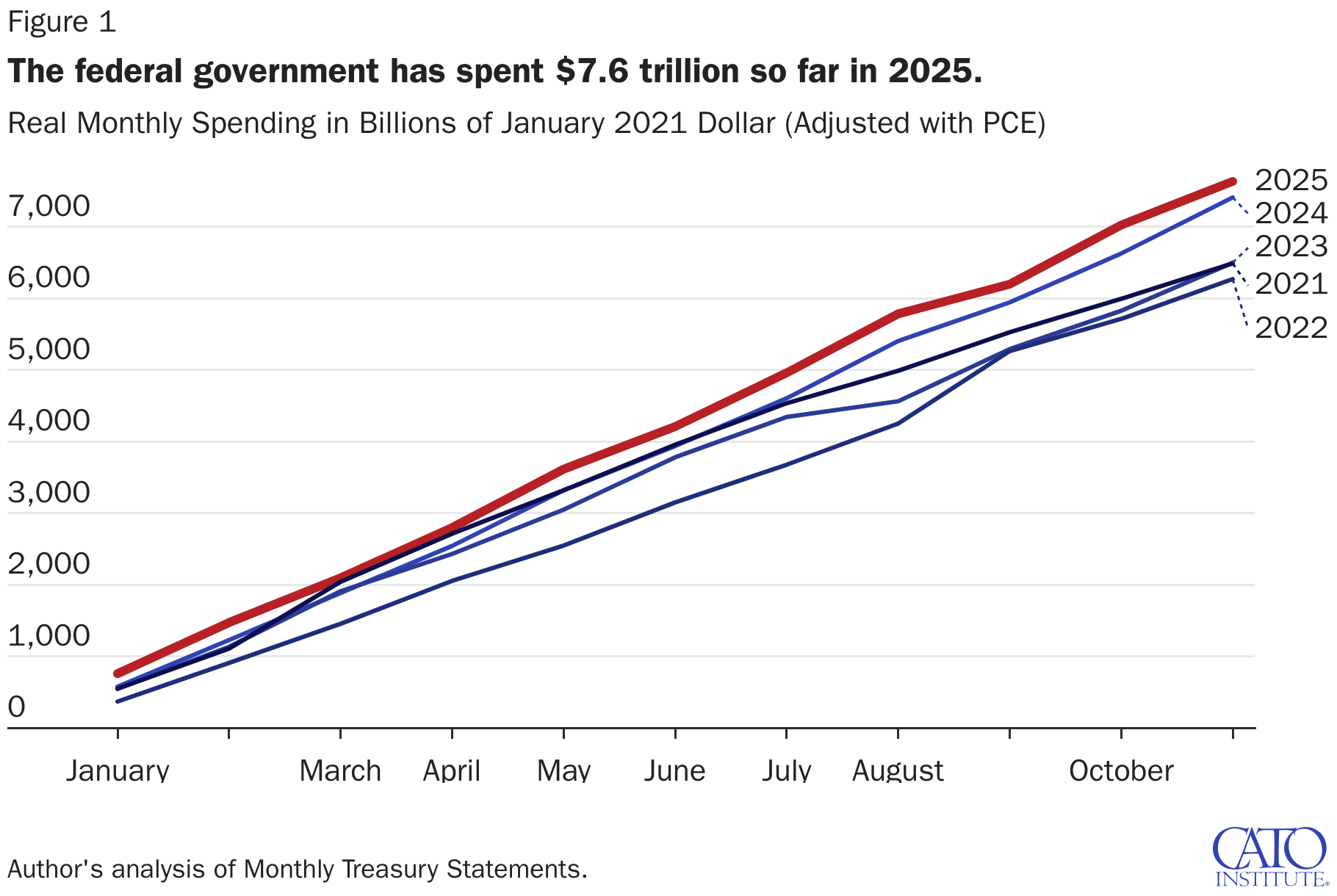
The CATO Institute reported in December 2025 that the federal government spent about $248 billion more between January and November 2025 (after DOGE) than it did in 2024 (before DOGE). According to the report, “Cumulative spending in every month of 2025 was greater than in every other year and was approximately as much as the Congressional Budget Office (CBO) projected in June 2024, or slightly less in real terms. There is no visible structural break in 2025 spending that coincides with DOGE’s start date.”9
Their chart of spending for 2025 (below) shows this trendline.
While the man in charge of these cuts sacrificed aid to some of the most vulnerable people in the world “to save the government money,” he continued accumulating unprecedented wealth for himself on the government’s dime. The companies that he owns, and that contribute to his vast wealth, have received billions of dollars in boosts from government funded contracts and tax credits in recent years.10
While businesspeople certainly have a right to be successful and enjoy the fruits of their success, at what point does this accumulation cross into the obscene? Even a small fraction of $1.2 trillion could make an incredible difference in the world.
Musk posted on Twitter in 2021 that he would sell part of his Tesla stock to give $6 billion to solve world hunger, if the U.N. World Hunger Program would provide him with a plan.11 The program’s director responded with a detailed plan within that budget, but Musk has yet to honor his pledge.12
In 2021 $6 billion was about 2% of his overall wealth, but today that percentage would be much smaller. He could donate that amount and still remain a trillionaire. In fact, he could donate significantly more to cover the (approximately) $72 billion U.S. foreign aid budget13 and still remain a trillionaire.
He has chosen not to do so.

What hoarding wealth does to a person
I saw a post online some time ago that pointed out the discrepancy in the way that we regard “hoarders”—like those we see on reality TV shows with houses full of newspapers or cheap collectibles—versus the way that we regard those who hoard wealth, natural resources, or power. The first group are generally regarded as mentally ill and in need of an intervention; the second are glorified and treated as if they hold some special genius to have accumulated SO. MUCH. STUFF.
But what’s the difference between them really? Is it not a form of mental illness that causes a person to cling to billions and trillions in their portfolios, while millions of their fellow humans suffer and starve around them? Is it not mental illness to have more money than you can possibly spend in multiple lifetimes, while children go hungry and die of preventable diseases?
After seeing it put so plainly, I have grown increasingly convinced that accumulating wealth in excess does something sinister to a person. Jesus and his disciples warned about it, of course, but many modern readers like to shrug off those parts of the Bible as metaphorical rather than literal.
We have been reading through the Gospel of Mark with our Sunday Bible study group, and we happened to be in chapter 10 the same week that the news about Musk was published. We read the story of the rich man who was seeking to “inherit eternal life,” but walked away grieving because Jesus told him to sell all that he had and give it to the poor.
As he was setting out on a journey, a man ran up and knelt before him and asked him, “Good Teacher, what must I do to inherit eternal life?” Jesus said to him, “Why do you call me good? No one is good but God alone. You know the commandments: ‘You shall not murder. You shall not commit adultery. You shall not steal. You shall not bear false witness. You shall not defraud. Honor your father and mother.’ ” He said to him, “Teacher, I have kept all these since my youth.” Jesus, looking at him, loved him and said, “You lack one thing; go, sell what you own, and give the money to the poor, and you will have treasure in heaven; then come, follow me.” When he heard this, he was shocked and went away grieving, for he had many possessions.
Then Jesus looked around and said to his disciples, “How hard it will be for those who have wealth to enter the kingdom of God!” And the disciples were perplexed at these words. But Jesus said to them again, “Children, how hard it is to enter the kingdom of God! It is easier for a camel to go through the eye of a needle than for someone who is rich to enter the kingdom of God.” They were greatly astounded and said to one another, “Then who can be saved?” Jesus looked at them and said, “For mortals it is impossible, but not for God; for God all things are possible.”
Mark 10:17-27
An interesting detail in verse 21 is that before Jesus told the man that he needed to sell everything and give to the poor, he looked at him and loved him. I imagine Jesus’ voice softening before he delivered the words that he knew would bring shock and grief to this man who wished to be faithful. Jesus was not telling the man to give away his wealth out of hatred, anger, or disgust, but out of love.
Perhaps he was thinking about how “those who want to be rich fall into temptation and are trapped by many senseless and harmful desires that plunge people into ruin and destruction.” (1 Tim. 6:9)
Perhaps he was thinking about the miseries that were to come upon the rich (James 5:1-6) or how “the lover of money will not be satisfied with money, nor the lover of wealth with gain.” (Eccl. 5:10)
What we know for sure is that Jesus’ warning about riches was rooted in his love for this man. Giving up the wealth would have been the best choice for him, but he wasn’t able to do it. He could not serve both God and wealth (Matthew 6:24), so he chose wealth.
There is another way
The part of the story of Musk reaching this shocking new pinnacle of wealth that grieves me the most is not the corruption of this man who was born wealthy and has built his life around his own desires and ego (although that is also pretty sad). It has always been this way with “great” men throughout history, and we have scores of palaces, mansions, and ancient ruins that testify to that reality.
What really grieves me is the way that everyday people, many of whom hold to the Christian faith, glorify this excess.
I mourn for the kids who have had this gross inequality and injustice normalized. I grieve that one of the most Lex Luthor of all living men is being praised as a hero or role model for our children, rather than exposed as the supervillain that he truly is.
To be clear, I still believe that Elon Musk is a human being with inherent dignity, who is made in the image of God. I also believe, however, that like the Pharaohs and Nebuchadnezzars of Scripture, Musk has forgotten it about himself. He dishonors himself, God, and all of humanity by thinking that he is a god himself.
The wealthy do not deserve to be honored for their penchant for excessive hoarding. They suffer from an illness that is far more damaging to their neighbors than the illness that leads others to fill their homes full of trash.
May we never be guilty of bowing down to the golden statues or kissing the rings of pharaohs who build empires on the backs of others with less power.
Instead of showing honor to people amassing great wealth for themselves, building their towers (or rocket ships) to touch the heavens and declare themselves gods, let’s honor God through our solidarity with those struggling to survive.
There is another way.
“In an economy that frames us as endless competitors, we must be communities of co-conspirators and co-laborers. We must and can, by the power of the Holy Spirit, show the world that there is another way.”
-Malcolm Foley, The Anti-Greed Gospel
See PBS article above
See USA Today article above. Note: this number was current as of Feb. 2026. The number is surely higher by now.
The 2023 foreign aid spending was $71.9 billion, according to Pew Research